Commuting to London from the East Midlands: A buyer’s guide
Commuting to London from the East Midlands can be quicker than many buyers assume, and that assumption can hold them back.
They picture two hours each way and a life timed to the minute. For several towns in the southern part of the region, the fastest direct services reach St Pancras in under an hour, setting you down in the capital from a front door that opens onto fields rather than a forecourt.
Since more of us began working partly from home, the appeal of the countryside seems only to have grown. A buyer who once made the same office commute five days a week now makes it on two or three, and the calculation changes entirely.
A longer door-to-door time that would have worn thin daily becomes easy to absorb when it falls only twice a week. Suddenly a stone village near Market Harborough, or a market town beside the River Nene, is not a compromise. It is the point.
The question, then, is where. The answer depends on the line you travel and the life you want around it.

How long does it take to commute to London from the East Midlands?
The short answer is that commuting to London from the East Midlands need not cost you the day: the fastest services from some locations reach London in under three-quarters of an hour, and even the slower of the places worth considering come in not far over the hour.
From Wellingborough, the quickest trains reach St Pancras in around forty-five minutes, and Kettering is much the same. Market Harborough sits just under the hour at its quickest, while Peterborough runs into King’s Cross on the East Coast Main Line in around fifty minutes. Corby is a little over the hour, as is Stamford, the latter via a short change at Peterborough.
These are the quickest scheduled trains, so a typical journey will run a little longer. Timetables shift and services vary, so treat them as a sense of what is possible rather than a promise, and check the current trains into St Pancras or King’s Cross before you let a journey time settle a decision.
Several of these smaller towns are faster to London than the region’s big cities, which changes where a careful buyer should be looking.
Commuting to London from the East Midlands cities: Leicester, Nottingham and Derby
Leicester, Nottingham and Derby anchor the Midland Main Line and all run direct to St Pancras, Leicester quickest at around an hour and ten minutes, with Derby and Nottingham nearer an hour and a half.
For anyone who wants the weight of a proper city, with its theatres, universities and restaurants, they make a sound choice, and the breadth of housing means a budget can stretch in several directions.
But if the shortest possible time on a train matters most, look further south. Wellingborough’s fastest services into St Pancras are quicker than Leicester’s and close to half the time of Nottingham’s, yet they set you down in open Northamptonshire countryside rather than a city centre.
For many buyers commuting to London from the East Midlands, that is the whole appeal.

Villages near Wellingborough, Northamptonshire
East of Wellingborough, where the fastest trains make St Pancras in around forty-five minutes, lies some of the quietest commuter country in the region.
The standout is Castle Ashby, a village arranged around the Elizabethan grandeur of Castle Ashby House and its gardens, where period cottages and estate homes take their cue from the great house at the centre.
Nearby, Grendon and Mears Ashby offer the same easy mix of stone, thatch and newer family homes, while Ecton draws people who want a good village pub and the community that tends to gather around one. None feels remote, yet none feels anything like a platform at rush hour.
Where to live near Kettering, Northamptonshire
Kettering matches Wellingborough almost exactly for speed, but the villages around it carry more history.
For many buyers, the draw here is Geddington, where the Eleanor Cross still stands at the centre of the village.
It is one of only three surviving monuments raised by Edward I to mark where his queen’s funeral procession rested in 1290, with daily life turning on the pub beneath it.
A little to the north, Brigstock keeps its stone cottages, its shop and its primary school, the makings of a working village rather than a commuter dormitory, while Loddington fills in with family houses built for the school run and the weekend.
Market Harborough, Leicestershire
Market Harborough offers something the villages cannot: a working town, with its fastest trains under the hour, that you can live in the middle of.
Its centre turns on the Harborough Market, a place of trade since the twelfth century and still busy several days a week, ringed by independent shops, cafés and restaurants. The Old Grammar School stands at the heart of it, a timber-framed building raised on wooden pillars that has become the town’s signature.
It is one of the region’s most characterful market towns, and the countryside around it carries the appeal further. Canal locks step down through Foxton, handsome brick houses and a few good pubs draw buyers to Great Bowden, and the Langtons, a loose family of villages taking in Church Langton, East Langton, West Langton and Thorpe Langton, offer stone cottages, ancient churches and the kind of community a village school sustains.
Villages near Corby, Northamptonshire
A few minutes more on the train buys a good deal more room to spread out around Corby, which rewards anyone commuting to London from the East Midlands who values space over shaving minutes off the journey. Its fastest services take just over the hour and run less often than at the busier stations, though getting to and parking at the station tends to be easier than at the larger hubs, which suits a week built around two or three days in town.
A landmark to match anywhere on the line sits at the edge of all this. The Welland Viaduct strides across the valley at Harringworth on eighty-two arches, the longest masonry railway viaduct in Britain and worth the detour whether or not you ever board a train beneath it.
Around it lie the stone-built villages of the Welland valley, among them Great Easton with its thatched cottages and village store, along with Stoke Albany, Caldecott and Middleton, all sharing the same unhurried feel.

Where to live near Peterborough
For sheer speed against character, Peterborough is hard to beat. Its fastest trains reach King’s Cross in around fifty minutes, among the quickest commutes anywhere on these lines, and the villages to its west are some of the most appealing.
Above the Nene valley, the twin villages of Castor and Ailsworth sit side by side, a mix of old stone and newer homes with a real community between them. A few miles north, Helpston was the birthplace of the poet John Clare and wears its literary past lightly.
There is charm too in Wansford, with its tea rooms and boutiques, though its position by the A1 means road noise reaches some homes, a point worth checking on the doorstep. Beyond them, a scattering of stone villages, Elton, Ufford, Southorpe and Warmington among them, offers the rural calm that a fast line into the city makes so easy to justify.
Then comes Oundle, with its Georgian streets, independent shops and well-known public school. For anyone weighing up commuting to London from the East Midlands while wanting a town with real cultural depth, it takes some beating.
Stamford, Lincolnshire
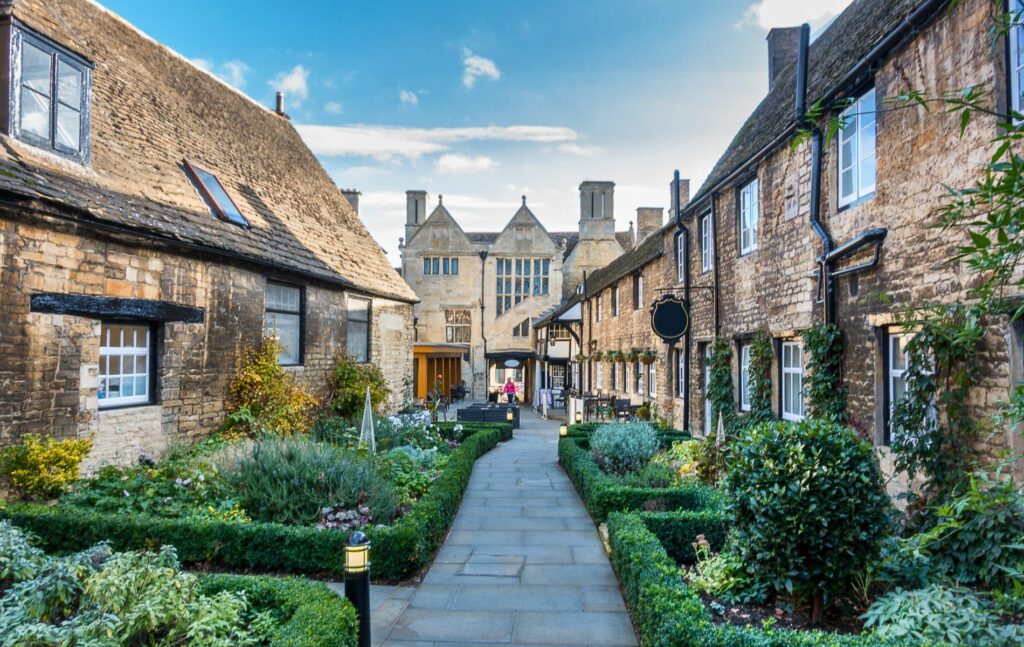
Stamford rewards the small amount of extra effort it asks. The fastest route into London runs via a short change at Peterborough and comes in at a little over the hour, quicker than its distance suggests.
The town itself is one of England’s most admired historic towns, a sweep of Georgian stone and a medieval street pattern that has stood in for period England on screen more than once. Housing runs from elegant townhouses to substantial family homes, the centre is full of independent shops and places to eat, and the calendar stays busy the year round, from the Burghley Horse Trials to the markets that fill the streets through the seasons.
For a buyer who wants beauty and amenity in equal measure, Stamford makes a compelling case.
Is commuting to London from the East Midlands worth it?
Whether commuting to London from the East Midlands is worth it depends, in the end, on how often you travel. A fastest scheduled train of around forty-five minutes from Wellingborough or Kettering sits comfortably within what most people find sustainable, and compares well with crossing London itself by Tube. An hour each way, the quickest figure from Corby or Stamford, is more than manageable on the two or three days that now define most office life.
We often meet buyers who arrive set on a single town and leave having chosen somewhere they had not considered.
They are won over by the realisation that ten more minutes on the train can buy a village they never tire of coming home to. The time you give to the journey, you may well get back in space, in setting and, depending on budget and property type, in what your money buys.
Commuting to London from the East Midlands
Few places combine real countryside, handsome towns and villages, and a fast train into the centre of the capital from the end of the road. Commuting to London from the East Midlands is not the compromise it once seemed. For many buyers, including those moving out of London to the region, it is the better arrangement.
Having made his home in Stamford and Rutland for many years, Ashley Banfield, Garrington’s Regional Partner for the East Midlands, is well placed to guide buyers considering precisely this move. He understands that the day-to-day reality turns on the particulars: which towns and villages combine a genuine sense of community with a dependable connection to London, and how a few miles in any direction can alter both the journey and the character of a place. Knowing an area at that level, along with the local relationships that can surface homes sold off the open market, is often what separates finding a house here from finding the right one.
If a move is on your mind, Ashley would welcome a conversation about the area and the options open to you. Please contact us for a no-obligation discussion.
Frequently asked questions about commuting to London from the East Midlands
Is a one-hour commute too long in the UK?
An hour each way is not unusual for rail commuters travelling into a major city, though whether it feels sustainable depends a great deal on frequency, reliability, onward travel at the London end and how often you make the trip. A direct service that gives you the option to work, read or simply switch off, which the Midland Main Line into St Pancras offers from towns such as Kettering and Wellingborough, tends to be far easier to live with than a shorter journey spent changing trains.
Where is it affordable and commutable to London from the East Midlands?
The towns and villages around Wellingborough, Kettering and Corby are worth weighing for their combination of value and speed, with direct trains into St Pancras and property that, for many budgets, may compare favourably with Home Counties commuter locations. Market Harborough and the Langton villages sit a step up in both price and polish, while Stamford and Oundle command a premium for their architecture and amenity.
What is the fastest train to London from the East Midlands?
Across these towns, Wellingborough and Kettering are the quickest, with the fastest direct services into St Pancras taking around forty-five minutes. Peterborough, on the line into King’s Cross, is around fifty. All are quicker than the direct services from Leicester, Nottingham or Derby, which is one reason the smaller towns reward a closer look. Times refer to fastest scheduled services and are timetable-dependent.
Is 40 minutes too long a commute?
Forty minutes is well within what most people consider a comfortable daily commute, and in the East Midlands it can place the centre of London within reach of thoroughly rural settings. For many buyers it represents close to the ideal balance between connection and quiet.